
The Sand
It will come for you

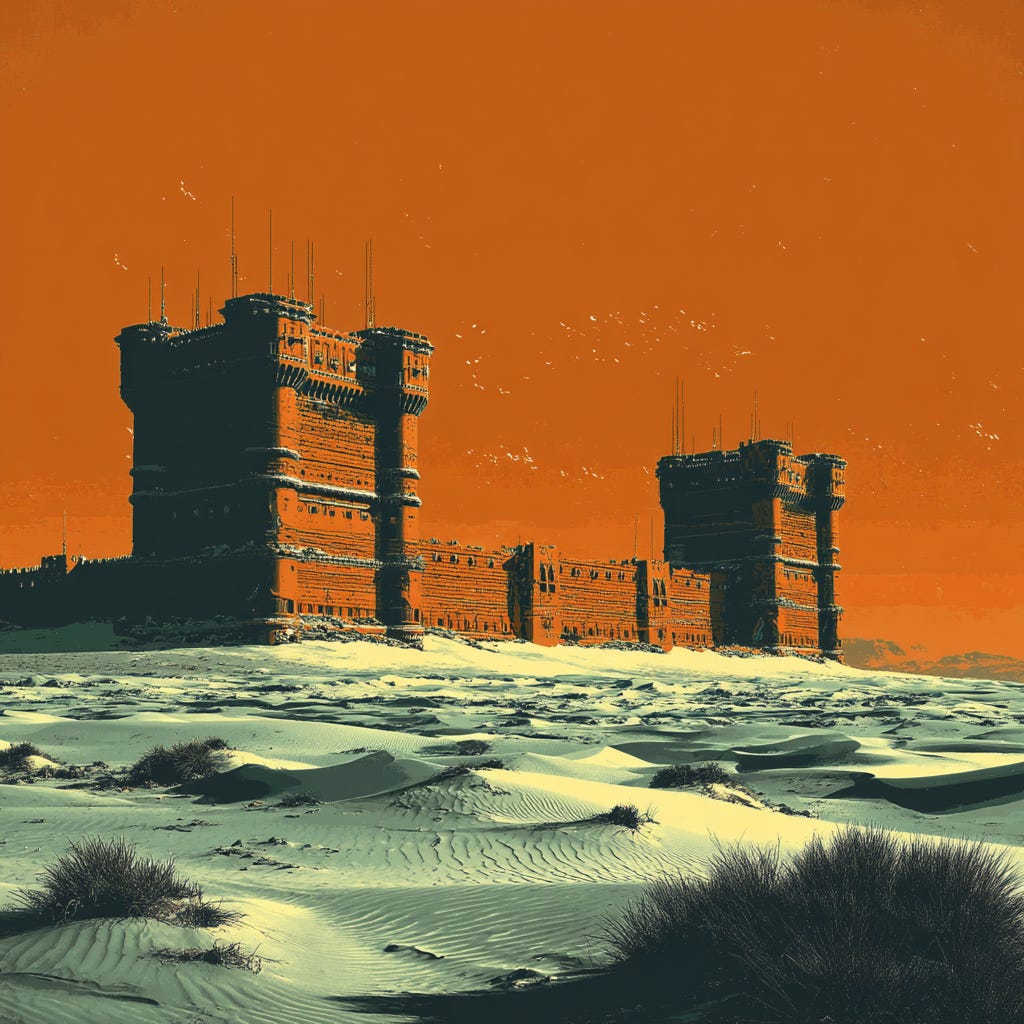
In late September, news reached Karegan that Silmain Fortress, the last Federation stronghold in the West, had fallen. The Defence Committee declared a three-day mourning period, canceling all entertainment and enforcing strict dress and restraint in speech, while the cleaning crews patrolling the streets were reinforced with additional personnel. The city, as clean as it was before, now was totally sterile, but this could not alleviate the grim tension that gripped the people of Karegan.
As the sun began to sink into the horizon, Shost walked along the outer wall and sat down on a stone slab heated by the day, looking outward, into the desert. He often came here when the city streets' grimness and the citizens' austerity became unbearable. In the ten years he'd lived in the city since the fall of his home settlement, Fort Al-Qamston, Shost had never gotten used to Karegan's purist lifestyle. And it was not even because he felt resentment for his dead countrymen, whom the local preachers, in their fiery speeches, held responsible for the catastrophe, saying that the Lord had punished them for their debauchery. The people of Al-Qamston were not carefree and overconfident. They just knew how to enjoy life, a talent long forgotten in buttoned-up Karegan. Shost even felt sorry for the locals. For all their ostensible readiness to fight, they just hadn't realized yet that they couldn't escape their fate. When the desert decides to commence full assault, they will lose their naive belief in invulnerability.
That was what depressed him the most. Of the people of Karegan, he was almost the only one who realized that all was futile, that the desert could not be defeated, and yet there was nothing he could do. So far, the city had held, but the sense of inevitability brought Shost back to the fortress wall, again and again. He would sit there for hours and stare out at the vast sea of sand that stretched to the horizon.
Sunset coloured the tops and slopes of the dunes in delicate shades of pink and purple. Just before nightfall, the inky tentacles of shadows crept from foothills and gorges between the sandy ridges to reach the walls of Karegan and melt in the bright light of downward-facing searchlights.
Above the hundred-meter walls of the city rose the observation towers, from which sentries kept a watchful eye on the nearest dunes. Shost had told the Defence Committee about the fall of Al-Qamston. The dunes had gradually crept closer to the city until one nightmare night, they had suddenly grown several times their size. Rushing rivers of merciless sand had swept over the city walls. They flowed through the streets, blowing out doors and windows, tearing off roofs and creating frenzied sand swirls in the squares and intersections. Shost was lucky: he was on guard duty on the opposite side of the perimeter from the breakthrough. Along with several dozen citizens, stricken with horror and despair, he managed to jump into two large commercial sandcars to rush away from the city, which had quickly become a mass grave.
The rest of his memory was a black area. He couldn't remember where the other sandcar had gone nor how most of his fellow getaways had disappeared. Only four survivors had made it to Karegan, and three died a few days later.
A long shout came to his ears as the guard change was underway on the towers. Soon, the sentries would start to patrol the walls, but Shost had already gotten to know all the guards. According to the rules, outsiders were not supposed to be on the wall after eight o'clock in the evening, but the sand guards, who dealt with the desert personally and not through sermons like most of the city's inhabitants, understood Shost better. Deep down, they, even those who outwardly adhered strictly to Puritan beliefs, realized that it was not the alleged debauchery that had caused Al-Qamston's downfall. The worm of despair had long dwelt at the bottom of every heart; the power of the desert was undeniable. Sooner or later, all the cities would fall, and the people would be left to huddle in the pitiful remnants of the cliffs to the east, squeezed between the vast expanse of sand.
The sun was almost over the horizon. The wall's stones began to cool rapidly, and the shadowy dunes threw at the city the first spears of the night's cold. Shost shivered and stood up, catching the last glimmers of sunlight. Only the edge of the purple disk remained above the horizon. At the very last moment, it suddenly flashed green and disappeared. The searchlights came on. They flooded the space below the wall with a dead-white light and seemed to freeze the sand streams, but Shost knew it was only an illusion. The desert was moving, breathing, looking for ways to penetrate the city it hated and to consume it, as it had done with hundreds and thousands of settlements in the West.
He rushed to the elevator without looking back as if an extra glance at the desert could turn him into a pillar of salt like Lot's wife. The elevator was busy: several guards were unloading crates of projectiles for static guns. These shells broke the bonds between grains of sand, destroying the dunes and any other spawn of the desert. You can't have enough shells for the whole desert, Shost thought, helping the guards, who met his help with silent gratitude: the crates were heavy. But ff we had some of those in Al-Qamston, we could have held out for another six months, if not longer. Six months... And then?
The streets were empty. There was no curfew in Karegan, but the townspeople would never have taken to the streets after evening prayers, except for occasional patrols of cleaners on the spotless sidewalk.
"Shost!"
He stopped so abruptly that he almost fell over. It can't be true! It was a voice he hadn't heard in years, not since the desert had swallowed Al-Qamston. And he was sure that his brother Nelt was dead; he had been on guard duty on the south wall, the one that had fallen first. Could he have survived?
Cherishing hope and at the same time fearing that he was dreaming it all from the nervous exhaustion, Shost turned to the voice.
In a side dead end, in the doorway of one of the houses against the city wall, his brother Nelt stood, waving at him. Shost, overtaken with joy, took a few steps toward him. But how did Nelt survive, and when did he come to Karegan? Several sandcars had arrived in the city recently, but they were all from the north. Could it be that Nelt had originally found shelter elsewhere and only now managed to get here?
"Not a good time for a walk, citizen."
Shost turned around. Behind him stood four men and one woman, all carrying vacuum cleaners. Two of them had static rifles hanging over their shoulders. A night patrol of cleaners.
Shost spread his hands.
"Sorry, citizens. Got late on the wall. I was helping the guards unload ammunition." There was a look of approval on the cleaners' faces at those words, and the woman smiled and nodded.
"That's commendable," said a tall man with a green armband on his sleeve, obviously the patrol leader.
"On days like this, we should all be concerned for safety, helping our defenders in any way we can."
Shost made an appropriately sanctimonious grimace and uttered a ritual phrase:
"The Walls Must Stand!"
"And the City Must Live," the patrolmen replied in unison.
"I met my brother," Shost explained, pleased that the atmosphere had lightened. "I haven't seen him in years. There he is, at the end of the alley. Hello, Nelt!" he shouted to his brother.
To his surprise, Nelt remained silent, though he kept making urgent gestures with his hand.
"Family first," the woman said with even more approval. "I'm happy for you and your brother. But don't stay out too long. Do you live far away?"
Shost shrugged carelessly.
"Not too close, but it's okay. I'll stay at my brother's if I have to," he said as he turned into the alley. "Right, Nelt?"
The brother was silent again. Strange, Shost thought, what's the matter with him? Had he lost the gift of speech? And he was waving strangely, like a winding mechanism... Was he sick?
"What's wrong with you?" He asked, approaching the house, where his brother stood in the doorway. "Too happy to say a word, or..."
Shost paused. In the light of the dim lantern above the door, he saw his brother's face: motionless, grainy, yellow-grey... It was a colour of sand. The same sand that flowed from his brother's pants and sleeves, spilled out of his full pockets and crawled out between the buttons of his shirt.
"Shossst." His name swirled in a sandy whirlwind along the street, though his brother's face didn't move. The lips remained closed, and as he looked closer, Shost realized with horror that they couldn't open. The brother's mouth was just a line drawn on the surface of the sand, like his whole face, an inept caricature of a sand sculpture.
Shost rushed away and caught up with the already distant patrol in a few great leaps. Before the surprised patrolmen could react, he snatched a rifle from one of them, took careful aim, and fired. His brother's figure immediately scattered in a heap of dry sand, but another copy stepped from the door, followed by another and another. They couldn't move fast enough, and Shost shot them as if at a shooting range, hearing the deafening wail of the alarm siren behind him. Someone started shooting beside him; someone shoved a spare magazine into his hand, and he kept shooting, reloading, and shooting.
Only when the sand flowing down the street slowed to a crawl, barely reaching Shost's feet, and the grotesque figures that now had only distinct resemblance with his brother began to scatter themselves at the door of the deserted building did Shost tiredly toss his rifle aside and wander slowly away, occasionally pushing himself against the wall to let the cleaning equipment and new patrols rushing to the breach site pass by.
Every now and then, he reached into his pocket. Chuckling with a flat, glassy laugh, he pulled out a small handful of sand and tossed it into the next dark hole in some back alley, where the grains of sand immediately disappeared from view like ants scattering in the thick grass.